

Assisted Suicide Helps Trump and GOP Ahead of 2028
Tucker, Massie, and other loonies Sister Souljah themselves. PLUS: China policy after the summit.

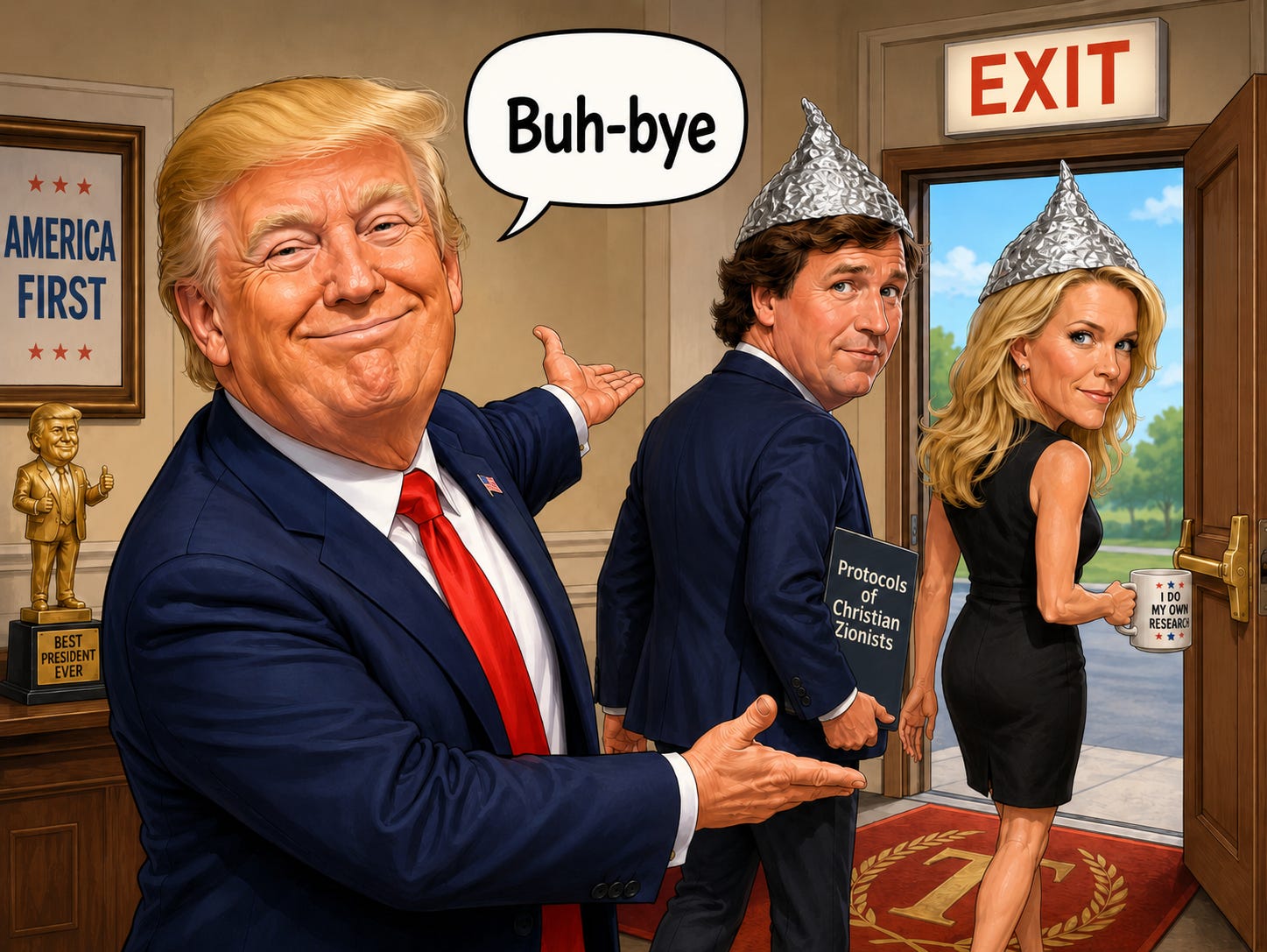
Assisted suicide for the mentally challenged is controversial. But when it is conducted by President Donald Trump on his opponents at their urging, the benefits are hard to dispute.
On Saturday, Louisiana Republicans fired Senator Bill Cassidy for sucking in general and voting with deranged and hysterical Democrats to impeach Trump for make-believe offenses. Two different Republicans are now vying to fill the Senate seat, Cassidy having come in third in his own primary. Another squish Republican goes down in flames.
Then on Tuesday, Kentucky Republicans effectively unseated Rep. Thomas Massie by defeating him in his primary in the heavily Republican district. Massie cast himself as a principled libertarian but voted against Trump’s signature One Big Beautiful Bill Act, which enshrined tax cuts and supply-side economic growth on a scale unseen since the Reagan era. Massie also voted against Trump and the Constitution through legislation that purports to limit the President’s authority to command the military to defend us against the theocratic tyrants in Iran. So much for the self-styled freedom fighter.
In a fitting spasm of antisemitism upon losing, Massie said his concession speech was delayed because he had to reach his opponent “in Tel Aviv.” As the satirical Babylon Bee joked in a headline, “Massie Blames Defeat On Jews Of Rural Kentucky.” The article deadpanned that Massie “could not overcome the losses in heavily-Jewish areas of backwoods Kentucky.”
Oy vey, Billy Bob.
Others who have charted the same course are not only gone but forgotten. Do leftwing political tabloids like CNN and PMS Now even have losers like Liz Cheney and crybaby Adam Kinzinger on their air anymore? No one knows.
Other recent volunteers whom Trump has accepted for assisted suicide include pundits Tucker Carlson, Megyn Kelly, and Candace Owens.
During the Biden administration, Carlson was second only to Trump in importance to the New Right and the information war with the left. More recently, he has popularized the once-obscure term “Christian Zionist,” called it a “brain virus,” and suggested those who support the Iran War are doing the bidding of Israel—presumably used as a stand-in for “the Jews.” He joins a long list of politicians and pundits whom Trump seems to have broken.
Megyn Kelly has always been a charlatan, drifting from establishmentarian to iconoclast depending on how it suited her. It takes unique flexibility to work for Fox News, then leftwing NBC News, and now fashion oneself as a keeper of the flame of true MAGA.
Then there is Candace Owens. The less said about her, the better.
Usually, there would come a point in a political cycle when the powers that be would be called upon to distance themselves from the loonies on their side. For example, any Republican candidate this year failing to demand that his Democrat opponent condemn biological males in women’s sports, drag queens in kindergartens, and systematic Somali clan theft of taxpayer funds would be missing a great opportunity.
Such a ritualistic distancing used to be called the “Sister Souljah moment.” That was the instance in the 1992 presidential race when candidate Bill Clinton, busy cultivating a since-concealed image as “Bubba” and moving toward the political center, denounced the performer Sister Souljah for advocating black-on-white violence. (In today’s Democrat Party, Sister Souljah would be the nominee on stage denouncing Bubba for moderation.)
But no such gesture is necessary thanks to the departing members of Congress who sought death-by-Trump and the intellectual excursions of Carlson and his peers. Trump already un-personed Carlson and Kelly in a single social media post calling them stupid. Since they speak for no mass of contributors, campaign management, voter registration, or get-out-the-vote work, they have no other political power to their name. Done and done.
This gives Trump and Republicans an advantage going into the 2028 presidential race. This year’s midterms will likely deprive Republicans of control of the House of Representatives, not because of any Democrat breakthrough on talking points about affordability. Rather, it will come from a lack of enthusiasm by Republican-inclined voters who don’t have a clear bogeyman like Hillary Clinton or Kamala Harris to motivate them.
But the real fight will be in 2028 for the White House and control of Congress—with the Supreme Court again hanging in the balance unless Justices Clarence Thomas and Samuel Alito decide they want Trump to choose their successors. For that race, Trump and his assisted-suicide service have already begun to lay the groundwork for success.
No one in the media will report it, but the economy is on sound footing and getting stronger. The Atlanta Federal Reserve Bank informally estimates GDP growth at a raging 4.3% annualized rate this quarter. Inflation is a little hot at 3.8%, but if one excludes energy and food prices driven up temporarily by the Iran War, the rate is a normal 2.8%. Despite forecasts of job-loss doom due to AI, total employment has never been higher, and businesses created 115,000 net jobs last month.
Forward-looking measures like the stock market, which at an all-time high reflects record business profitability, and business-capital formation being driven by strong long-term capital expenditures, foretell strong economic growth. The media has successfully cast the economy as poor—consumer sentiment surveys demonstrate this—and each passing week makes it harder for Trump to reverse this belief. But the truth will prevail in 2028 as the economy accelerates steadily and unmistakably.
And it’s not just the economy driving matters. Foreign policy and Trump’s dismissal of loonies will help too. The New York Times and the rest of the Democrat-media storytellers are gleefully reporting a rift on the right over foreign policy. The cause is Trump’s decision to decapitate the Venezuelan government, threaten Cuba’s communist government, and recognize the state of war that Iran has had in place against the United States since 1979.
The 2028 Republican campaign will have a huge debate over foreign policy but, barring disaster in Iran, the outcome is already decided. The reason is that the future of the party only gets settled when there is a presidential nominee. Given his recent display of power, Trump has removed any doubt that the 2028 nominee will be whomever he chooses. And don’t expect Trump to choose anyone who is not an enthusiastic supporter of the aggressive and assured foreign policy that he and Secretary of State Marco Rubio have orchestrated. Thanks to their antisemitic dalliances and subsequent banishment, the noninterventionists have already all but removed their arguments and candidates from contention.
Parting Shot
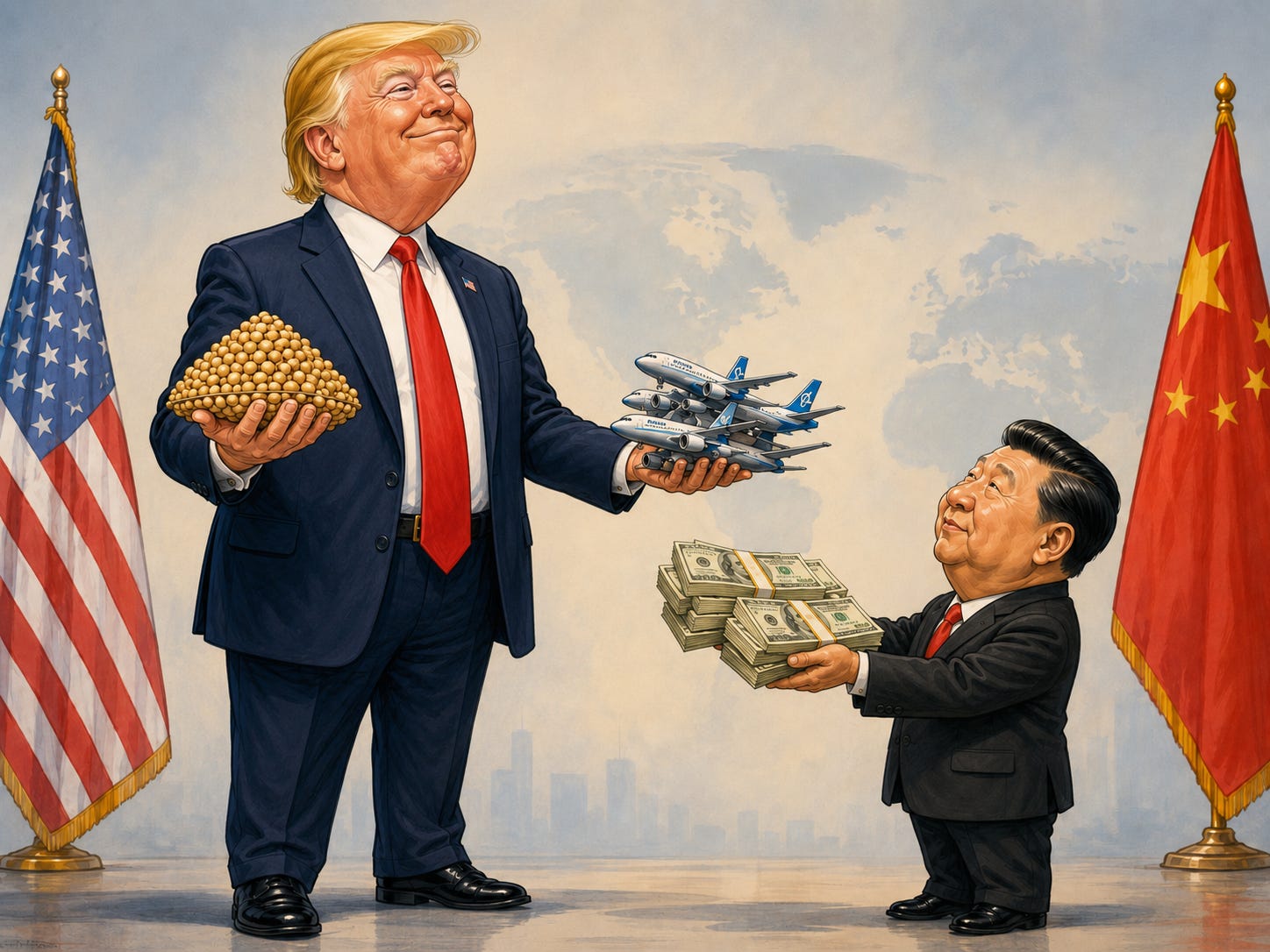
President Trump had a successful summit with Chinese supreme leader Xi Jinping in Beijing. Reagan-era Secretary of State George Shultz characterized such high-level interaction as necessary “tending the diplomatic garden,” and garden Trump did.
While the media pretended Trump was weak and Xi was strong, it was Trump who brought with him a group of the world’s most powerful CEOs—all Americans, of course. It is Trump who has crimped China’s Iranian energy supply. The economy Trump leads is accelerating and vindicating capitalism; Xi’s communist economy has been floundering since the pandemic. It is Trump who can wage war around the world from the cabin of his 747, while Xi, the leader of a nation of one billion people, can’t even invade puny Taiwan.
Beijing’s obsession with Taiwan is a weakness, not a strength; Xi’s buddy, Russian President Vladimir Putin, wouldn’t even notice if a geography as small as Taiwan came or went from Russia’s 11 time zones.
As a result of the summit, more U.S. soybeans will apparently be heading to China. That is good because it’s better for everyone if Chicoms eat more tofu and fewer bats, pangolins, and dogs.
Trump again bucked simplistic descriptions that he is transactional and soft on authoritarians when he pressed Xi to release dissident Jimmy Lai. This was at least the second time Trump has done so directly, even though mention of Jimmy, a Hong Kong publishing tycoon who peacefully stood for freedom in China during protests, causes noticeable anxiety in Xi. Trump is also doing the work for the Vatican: Jimmy is the world’s most famous Catholic layman and a symbol of Christian self-sacrifice that the pinko papal politician, Pope Leo, chooses to ignore.
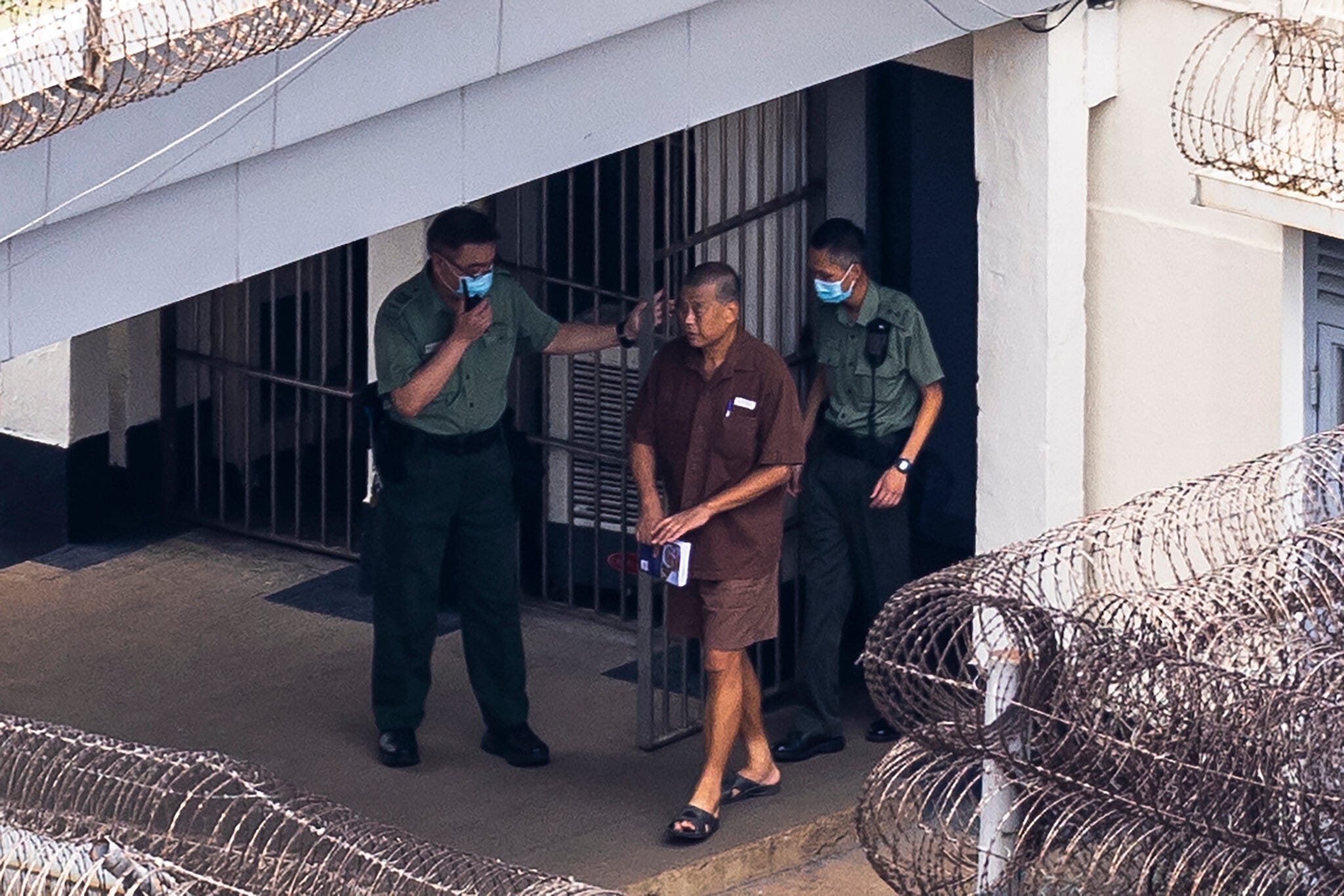
Perhaps Xi will expel Jimmy to a retirement of reclusion rather than irreversibly make him the Chinese martyr of the century, and dress it up as a present to Trump before their next summit later this year. The record already shows that Trump has pressed the Chinese harder on a real human-rights issue than any president in U.S. history. Trump has also tried hard to find areas to tone down confrontation with China--something Xi should not ignore or take for granted.
Meanwhile, reporters, pundits, and politicians who facilitated China’s rise before Trump changed America’s course are suddenly concerned that Trump is going soft because he had a plain-language conversation about Taiwan with Xi and was gracious about the dictator’s tenure.
Truth be told, I’m not 100% sure what our China policy is today. We’re not back to Bush-Obama “responsible stakeholder” nonsense that wishcasts China will be friendly once it steals enough of our manufacturing. But also missing is a simple plan like that espoused by Trump’s first-term U.S. Trade Representative, Bob Lighthizer, who calls for “strategic decoupling.”
Hopefully strategic decoupling is still the tacit plan, and Trump is just playing it a little nice while he wields military force in the Middle East and the Americas, fights trade wars with Europe and Canuckistan, and sources rare earth elements and processed rare earth compounds from anywhere but China.
However, as I noted to Le Figaro this week, Trump’s impatience with Taiwan’s dazzling sideshow and woke left-leaning government is probably genuine and deserved:
… They have someone over there who wants independence,” [Trump] said, even though Taiwan’s government has never said it wants to declare independence. But the message is clear: “The reality is that the White House considers Taiwan a source of instability,” says Christian Whiton, a former State Department adviser during the first Trump administration.
The setback is severe for Lai Ching-te, who had nevertheless worked to strengthen relations with the United States and the Trump administration. To meet its expectations, the government pledged to increase the defense budget and supported investments in the United States by its most strategic companies — especially TSMC, Taiwan’s industrial jewel, which produces the world’s most advanced semiconductors. But that was not enough, nor were the interviews given to conservative American media to appeal to the MAGA sphere. “The Lai administration’s plan to influence Trump has failed. Taipei chose the wrong intermediaries, the wrong allies, and the wrong lobbying firms because it does not really understand Trump,” Christian Whiton concludes.

Excellent writeup; entertaining read. Much improved over “let’s nuke Iran, just a little”!
November is a long way off in political time, and I expect whatever Trump accomplishes in the next 5 months will bode well for the midterms.